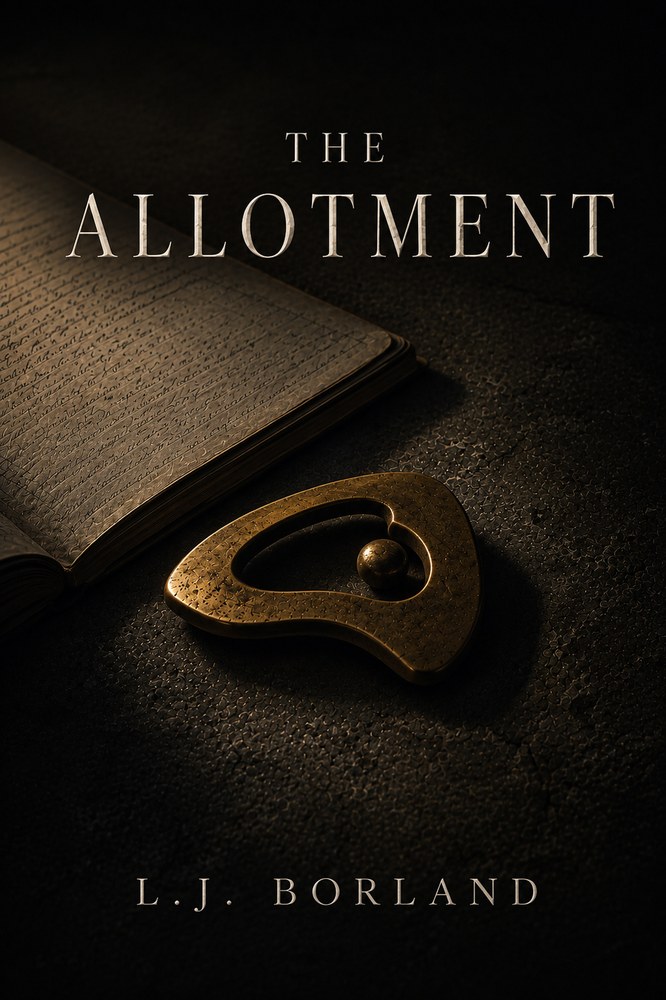
About the book
In the city of Halvet, the dead are permitted one final testimony. How much they're given depends entirely on how they died.
Marit has been an Allotter for twelve years — a licensed officer of the court whose job is to call the recently deceased back to their last window and extract whatever the law needs from it. A quick death earns a word. A slow one earns more. She is the best at what she does, which is why they give her the hard cases, and why she has spent twelve years learning not to feel them.
Hugo Vale died of a slow poison over nine days. No one takes nine days by accident.
A steward of thirty years to one of Halvet's great houses, Hugo chose his dying the way he chose everything — deliberately, to the grain, with a purpose no one was supposed to understand until it was too late to stop. He chose the window. He chose Marit. And across nineteen days of testimony, one careful story at a time, he begins to build something she doesn't yet have the architecture to receive: a map, pointing at a buried word, a dead man's name, and a house that has spent nine years keeping a silence it cannot allow broken.
The map ends at her brother.
Marit has an irregular case record, a trial date set to run against her deadline, and a Magistrate who would very much prefer she find nothing. She has, for eleven years, been carrying a single word she has never been able to open.
Hugo Vale spent nine days buying her the key.
The Allotment is a novel about testimony and grief, about the difference between a system that extracts the truth and a person who finally learns to hear it.
Discussion questions
- The Allotry can recover only as many words as a person's dying "allotted" them — an instant death yields a single word, a slow one yields more. If you had one word to leave, what would you spend it on? What would nine days change?
- Marit refuses to learn a victim's name before a calling because "a name is a lens." Where does she treat distance as discipline — and where does that same distance become a way of not-seeing?
- Hugo Vale spends six months and his own measured suffering to buy a nine-day window. Is his choice courage, love, vengeance, or control — and can it be more than one at once?
- Hugo makes Emilia administer the doses knowing she'll believe she killed him. She calls it "either the greatest act of love or the most significant betrayal" and can't tell them apart. Should she be able to? Can you?
- Marit learns to stop being "an extractor of the dead" and become "a witness" — to let one word mean what it means rather than working it like a seam. What's the difference between extracting information from someone and truly hearing them?
- The testimony of the dead is the one instrument in Halvet's law the powerful can't silence. What are the real-world equivalents — the testimony a society treats as incorruptible, and the ways power still tries to manage it?
- Dreva writes the truth in language ("inconsistent with therapeutic dosing") that's accurate and conveniently deniable. Where have you seen institutions tell the truth in a way designed not to be heard?
- Orre tries to buy Marit not with a threat but with kindness — easier cases, "a coat held out in the cold." Why is the kind version harder to refuse than the threatening one?
- The woman reciting numbers in the doorway mirrors the dead: holding one fact, turning it, saying it again. What is the novel saying about the people and things a city decides not to look at?
- By the end, Marit understands grief as something carried, not resolved — "the weight that proved the worth." Is "it was, all of it, enough" a hopeful ending, or something other than comfort?
Talking points
- The ethics of attention. The book draws a hard line between extraction and witness — taking testimony versus being present to a person's last words. Discuss attention itself as a moral act: what we owe the dying, the grieving, and the overlooked, and why being heard can matter more than being helped.
- Agency and dignity in dying. The "allotment" makes death's meaning depend on how one dies and what one says; Hugo turns his own dying into authorship. What does it mean to claim authorship over your death, and where do intention, suffering, and dignity meet?
- Truth versus power, and the incorruptible witness. A man weaponizes his death to force a truth into a record the powerful can't suppress. A way into whistleblowing, the law's deference to influence, and the machinery — Orre's timed order, Dreva's deniable phrasing, Renn's quiet courage — by which truth is buried or made un-buriable.
- Complicity and neutrality. Marit's carefulness is both her integrity and her evasion — "the gap the Allotry pretends does not exist." When does professional detachment protect justice, and when does it become not-seeing? Is neutrality inside an unjust system ever truly neutral?
- Love that harms. Hugo loves Emilia and uses her, and the novel refuses to resolve it into one clean thing. A framework for paternalism and consent: is it ever loving to decide, without someone's knowledge, what they must suffer — for their own good, or a greater one?
- Grief as carrying, not closure. Against a profession built to make grief smaller through distance and form, the book argues grief is meant to be carried, and that the carrying is the evidence of what was worth grieving. Hold this against our cultural scripts for "getting over" loss.
- What a society refuses to see. The reciting woman, the great houses and beggars in their "mutual unsurprise," the work done below the level the city will "admit what it asks of the dead." How do communities sustain themselves by practiced not-looking — at the poor, the ill, the inconvenient?
- Meaning lives in reception. "Vennel" means nothing for eleven years, then everything — unchanged in itself; only the knowing changes. A prompt on how meaning lives in the hearing rather than the word alone, and how that's true of testimony, evidence, scripture, and the stories families tell about their dead.
About the author
L. J. Borland writes adult literary fantasy from the high desert of southern Arizona — stories where the mythic presses up against the ordinary world, and neither comes away unchanged.
Over two decades in the making, the Ring Keepers saga sits alongside a shelf of standalone novels that range from frontier legend and occult ledger to the long cold of a forgotten king, and a science-fiction epic at the threshold of the unknown.
Where to find it
Available on Amazon (paperback & ebook). Listed on Goodreads.